
Compare Butte County Property Value Types
The county GIS map shows several assessment fields. No single one answers what a property is worth. Read each number in its record context instead of substituting the tax bill for the underlying assessment.
| Value | What It Is | Where |
|---|---|---|
| Land value | Assessment attributed to land | GIS/Assessor field `PS_LAND` |
| Improvement value | Assessment attributed to improvements | GIS/Assessor field `PS_IMPROV` |
| Total, exemption, net | Roll value, recorded exemption, and remaining net | `PS_TOTAL`, `PS_EXEMPT`, `PS_NET` |
| Sale price | Consideration or sale evidence requiring instrument context | Recorded deed and verified sale sources |
| Current opinion of market value | Parcel-specific opinion for a transaction date | Licensed appraisal, not the GIS |
Idaho's ratio study divides assessed value by sale price. It tests assessment levels across groups of property. The study measures how whole groups of parcels are assessed, never one Butte County parcel. A deed's stated consideration can also hide unusual terms, multiple parcels, personal property, or a family transfer, so pull the deed records before treating that price as a clean comparison.
Estimate a Butte County Property Value From Records
Build the estimate from dated sources rather than choosing the first number returned.
- Search the Butte County GIS app by address, parcel number, or owner/mailing name.
- Record parcel ID, acreage, category, tax area, value fields, exemption, legal text, map date, and assessment year.
- Ask the Assessor at (208) 527-8288 how the roll treats the land, improvements, category, and parcel configuration.
- Request the relevant deed from the Clerk/Recorder if a transfer price or date is being used as evidence.
- Compare genuinely similar sales for the correct date, then use a licensed appraiser when a transaction requires a current opinion.
- Assessed value
- The value carried on the assessment roll.
- Net value
- The configured value remaining after the recorded exemption field.
- Sale price
- A transaction figure whose instrument and terms need review.
- Assessment ratio
- Assessed value divided by sale price in Idaho's ratio-study method.
Explain Why Butte County Values Change
Assessments move for many reasons. A new assessment year, an added or removed improvement, a land reclassification, a fresh exemption, or a parcel split can each change the figure. Each event lands on its own schedule. GIS, the tax roll, the tax account, and recorded deeds may update at different times. Save the old and current parcel IDs. Ask the Assessor which effective date applies, since a deed explains ownership timing but not how land and improvements were valued.
Read Idaho Ratio Studies Correctly
The State Tax Commission compares assessments with verified sales. That ratio is assessed value divided by sale price. The results describe groups of property and test uniformity across classes. They do not value one parcel. No category statistic can account for a building's condition, an acreage issue, a legal restriction, or unusual transfer terms. Cite the study year and class, then return to parcel-specific evidence.
Assemble Evidence for a Value Review
Start with the assessment notice itself. Pull the GIS fields, the parcel number, the legal description, the category, the acreage, and the tax year. Lay them side by side. Dated photographs and your own measurements belong in the file too. They show condition at a specific point in time.
Comparable sales carry the most weight when they match location, use, size, quality, and condition. Retrieve the deeds behind each sale. That step keeps family transfers and multi-parcel deals from being mistaken for ordinary market transactions. Ask the Assessor for an explanation before you file anything. Verify the formal board of equalization form and the deadline tied to the fourth Monday in June.
Reach Butte County Value Records Offline
The Assessor accepts parcel inquiries at (208) 527-8288 and at 205 West Grand Avenue in Arco. A county public-record request should state the parcel, the years, the exact assessment documents wanted, and whether you prefer to inspect or copy. The Treasurer answers tax bill questions; the Recorder supplies deeds and plats; court files may explain litigation.
Label every source you gather. None of them substitutes for the assessment record the Assessor maintains, so treat each as support rather than the foundation of your value case.
Know the Limits of a Butte County Assessor Value
An assessment exists to run the property-tax system. It is not a guaranteed sale result, asking price, or replacement-cost estimate. It is also not a mortgage appraisal, boundary survey, or environmental opinion. Parcel maps can lag. A split, combination, deed, exemption change, or improvement update may not appear yet. Save the retrieval date and ask which assessment year the number represents.
The Treasurer's bill is separate. It applies tax-area and collection details to the roll. Payment status proves nothing about market value. For bills and installments see the property tax records guide.
Value is not price. A Butte County assessment does not predict the amount a buyer will pay. Obtain a licensed appraisal when a purchase, financing, estate, or dispute requires a current parcel-specific opinion.
Challenge the number with facts, not frustration. Bring measurements, condition evidence, photographs, the legal description, survey material when relevant, and comparable sales matched to the valuation date. Start with the Assessor. Idaho's formal board of equalization deadline ties to the fourth Monday in June, so confirm the current form and date promptly. An informal chat may not preserve a formal appeal.
The Idaho State Tax Commission ratio-study page explains the statewide comparison framework. Its statistics describe groups, not one property. If GIS is unavailable, use the Assessor's counter, phone, or a focused written request. Name the parcel ID and tax year. Add the exact fields and your inspect-or-copy preference.
Explain Changes in Butte County Property Value
Values shift for familiar reasons. A new assessment year, added or removed improvements, land classification, an exemption decision, or a parcel split or combination can all move the number. Those events reach GIS, the roll, the tax account, and recorded instruments on different schedules. Keep the old and current parcel IDs. Ask the Assessor which effective date applies. A deed shows transfer timing, not the county's land and improvement calculations.
Use Idaho Ratio Studies at the Right Scale
Ratio studies measure fairness, not price. The State Tax Commission lines up assessed values against verified sales. It monitors assessment levels statewide. The ratio itself is assessed value divided by sale price. Results describe property groups and test uniformity. They never assign a value to one Butte County parcel. No class statistic captures a building's condition. It also misses an acreage problem, a legal restriction, or odd sale terms. Quote the study year and class, then get back to parcel evidence.
Assemble a Butte County Value Review Packet
Start with the assessment notice itself. Pair it with the GIS map view and the parcel number. Add the legal description, category, acreage, and the value figures for the year in dispute. Photographs, careful measurements, and honest condition notes make the packet credible. Comparable sales belong in it too, matched by use, location, size, quality, and valuation date. Pull the deed records behind each comp. Family transfers and multi-parcel deals should never masquerade as ordinary sales.
Ask the Assessor to walk through the record first. Many disagreements end there. If formal review is still warranted, file the board of equalization form by the fourth Monday in June. Keep proof of timely filing. Keep two paths straight. Correcting parcel facts is one thing, and contesting the Assessor's valuation judgment is another.
Compare Historical Values Without Mixing Parcels
An old tax bill only means something once its legal description ties to the parcel you hold today. Splits and combinations shift acreage and improvements among successor parcel numbers, so a naive year-to-year chart can mislead badly. Build an identifier timeline from recorded instruments, plats, and confirmation from the Assessor. Only then calculate a trend.
History runs deep here. The Idaho State Archives keeps county land, property, and tax material back to 1863, and FamilySearch holds Butte County land and probate images from 1882 through 1970. Those collections document the past. They will not price the parcel now. Cite the archival item, then bridge it forward through the recorded deed records.
Review the Official Idaho Ratio Source
Open the Idaho ratio-study page before reading the captured official source.
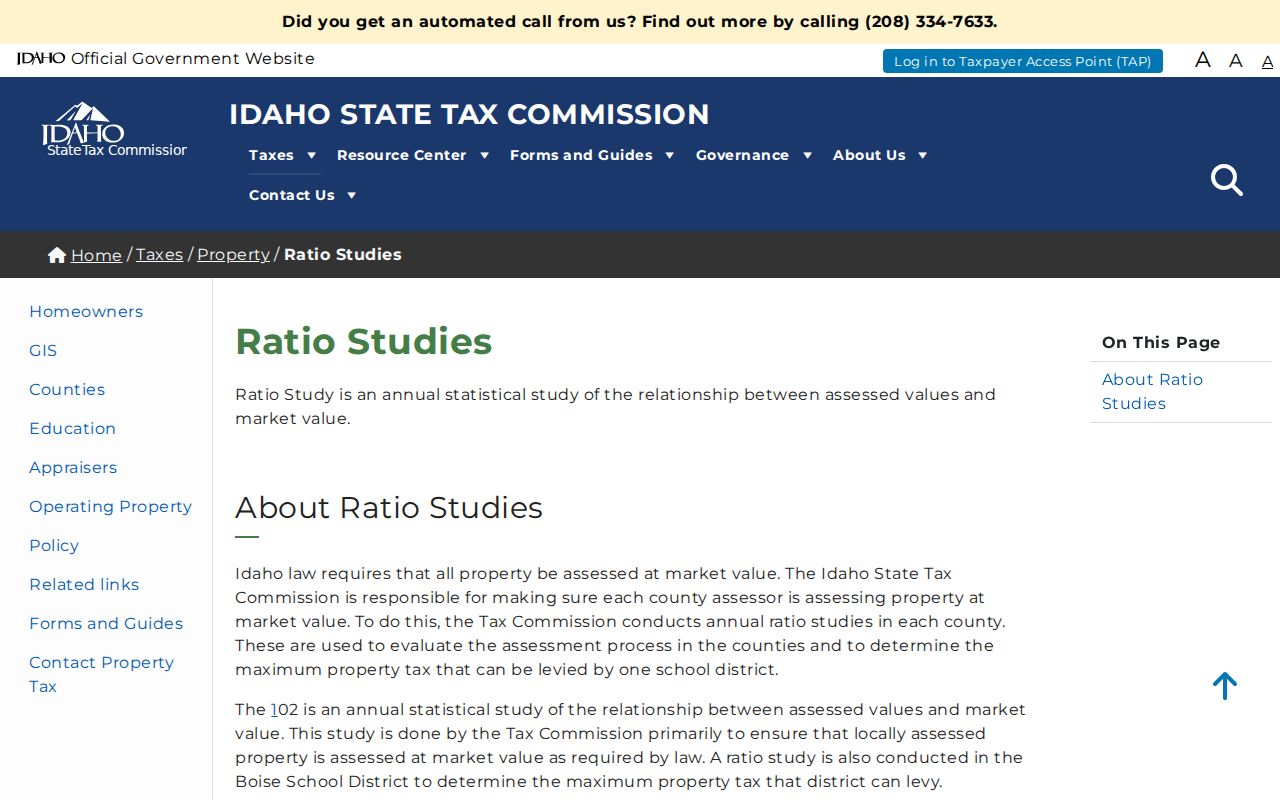
The capture supplies statewide context, not a parcel appraisal.
Check your numbers before comparing years. Total value and net value are not the same field. A parent parcel should never be stacked against one successor lot. Record exemption amounts apart from everything else. When the Assessor corrects acreage, category, or improvement data, note the correction date and the first tax roll year it touches. That audit trail explains a value change far better than an undated screenshot. It also beats a third-party appraisal estimate.