
Read Butte County Property Tax Records
Two different offices hold the money answers for Butte County property records. The State Tax Commission hosts the county GIS app. It shows value fields tied to each parcel. The Treasurer keeps the account side. That office bills and collects the real, personal, and operating-roll taxes. Keep the parcel ID handy with every question. A shared mailing address or a spelling variation can pull up the wrong account fast.
| Field | What It Shows | Where |
|---|---|---|
| Total, land, and improvement values | Components of the value carried in the GIS parcel data | Assessor/GIS |
| Exemption and net value | Recorded exemption amount and value remaining after it | Assessor/GIS |
| Tax area | The parcel's tax-area identifier, useful when checking levies | Assessor/GIS |
| Bill and payment status | Amounts billed, received, late, or still due | Treasurer |
| Legal and parcel identifiers | The keys used to reconcile the tax account with land records | GIS and county files |
An assessed value is not a sale price. Idaho ratio studies weigh assessments against verified sales in the aggregate. The reported ratio simply divides assessed value by sale price. That study grades how well assessments perform across the board, so it never works as an appraisal of a single Butte County parcel. A recorded deed proves a transfer happened. But the deed alone says nothing about the current taxable value or the balance still owed on the tax roll.
Follow Butte County's Billing Calendar
Butte County sets its tax bill calendar by statute-backed dates. The Treasurer issues bills by the fourth Monday in November and mails them for each parcel not coded to a mortgage company. The first half comes due December 20, or the next business day. The second half is due June 20, or the next business day. A notice that never arrives does not excuse the late charge or interest, a point the county anchors to Idaho Code section 63-905(9). If a lender normally pays your property tax, reconcile the parcel and account anyway. The mailing code alone does not prove the bill was paid.
Late payments cost extra here. The county describes a 2% late charge plus daily interest that starts January 1 and runs at 1% per month. How that applies can hinge on the account and the payment date, so confirm any payoff figure with the Treasurer before sending funds. Cash, check, money order, cashier's check, and credit card are the listed payment methods. The card fee is stated at 2.5%. Terms like these shift over time. Ask the office whether they still hold before you rely on them.
Separate Parcel Values From the Tax Account
The GIS configuration labels its value fields as `PS_LAND`, `PS_IMPROV`, `PS_TOTAL`, `PS_EXEMPT`, and `PS_NET`. Tax area, acreage, category, and legal-description fields sit alongside them. Treat all of it as assessment data attached to the mapped parcel. The Treasurer's account remains the source for what was billed and received. A mismatch between the map and the tax bill is rare but real. When it appears, save the parcel ID, the map date, the tax year, and the exact field labels. Do this before calling.
| Question | Best first source | What to retain |
|---|---|---|
| How was the parcel valued? | Butte County Assessor | Parcel ID, year, land and improvement fields |
| Was the installment paid? | Butte County Treasurer | Tax year, receipt, date, account identifier |
| Does a recorded lien or deed affect title? | Clerk/Auditor/Recorder | Instrument, parties, recording date |
Look Up a Butte County Tax Bill
The county's online payment page is built for making a payment, not for browsing a full tax history. Treat it as a way to pay a Butte County tax bill, and go to the Treasurer or Assessor for a verified record of past bills.
- Use the official Butte County GIS Mapping app to find the property by address, parcel number, or owner/mailing name.
- Copy the parcel ID, property address, tax area, and value fields exactly as displayed.
- Contact the Treasurer at (208) 527-3047 for the current bill, installments, payment status, or a dated payoff.
- Compare the exemption and net-value fields with the Assessor's explanation; request correction or review from the office that owns the disputed field.
- For a recorded tax deed, lien, or release, request the instrument from the Clerk/Recorder rather than treating a notice as the final title record.
- Assessed value
- The value placed on the assessment roll; it is not automatically a sale price.
- Levy
- The tax charge applied through the relevant taxing areas and budgets.
- Exemption
- An amount or status reflected in assessment data when the parcel qualifies.
- Tax lien
- A claim arising from unpaid tax; its current status requires the supporting account and, when recorded, the instrument.
Challenge a Butte County Assessment
Idaho's assessment cycle starts with the assessment notice. From there, the county board of equalization is the formal appeal route. The filing deadline ties to the fourth Monday in June. Contact the Assessor early. Name the parcel and tax year. Ask how the land, improvements, category, acreage, and exemptions were each applied. The strongest evidence is parcel-specific: photographs, measurements, and condition facts. A survey or legal description helps where it matters. Comparable sales should truly fit the valuation date and property type.
Protect the review window. Confirm the current filing deadline, form, and hearing requirements with the Butte County Clerk or Assessor. An informal conversation does not necessarily preserve a formal appeal.
The Idaho State Tax Commission's property-tax guidance lays out the statewide framework, and it also helps you separate a value dispute from a bill-calculation dispute. The Assessor maintains the tax roll; the Treasurer collects payment. Aim your challenge at whichever office can actually change the disputed record.
Check Exemptions Without Assuming Eligibility
The county GIS map shows exemption and net-value fields on parcel popups, but a number there says nothing about eligibility, application status, or a pending change. The State Tax Commission publishes an official homeowner's exemption page worth reading first. Then ask the Butte County Assessor which application, occupancy evidence, and deadline currently apply. Never copy an exemption from a neighboring parcel. Never infer qualification from an owner's age, mailing name, or property category.
If ownership, occupancy, or parcel configuration changed, pin down the effective date. A deed, split, combination, or move can leave records updating on different schedules. Keep both the assessment year and the recording date handy when you ask why an exemption is missing or differs from an earlier bill.
Trace Delinquency, Tax Deeds, and Excess Proceeds
Delinquent taxes in Butte County can show up in public notices. A notice is only a lead, though. The notice archive is not an account ledger. It is not a title index either. Start with the Treasurer to pin down the account itself. Then pull the recorded deed from the Clerk/Recorder so the paper trail holds up in writing. When litigation has reached the courts, the District Court clerk holds the case file. A newspaper item, a meeting minute, or a search snippet should never be treated as the last word on a parcel.
Tax-deeded sales sometimes leave excess proceeds behind. Those funds follow the parties in interest first. Any remainder moves to Idaho unclaimed property. Confirm entitlement with the office that actually holds the money. If an unsolicited finder contacts you over a mere name match on Butte County property records, decline to pay. Never post account details to pressure an owner of record.
Use Every Butte County Tax Access Channel
Two online channels come first: the GIS map and the Treasurer's payment route. Neither one is the only path. A phone call to the Treasurer works. So does a visit or letter to Butte County Administration at 205 W Grand Avenue. Mail goes to PO Box 121, Arco, Idaho 83213. The Assessor sits in the same building and takes parcel questions at (208) 527-8288. When a specific county record is needed, routine account service cannot always produce it. The county public-record request form is the right instrument.
That form asks for requester and contact details. It also asks for a clear description of the record, an inspect-or-copy choice, a signature and date, and the statutory acknowledgment about mailing and telephone lists. Idaho Public Records Law sets timing and fees that shift with residency and scope. Naming the parcel ID, tax years, and exact account documents helps the custodian. It lets them pull the right set quickly.
Build a Defensible Tax Record Packet
Label every source instead of blending them. Save the GIS popup as assessment evidence. Get Treasurer confirmation as tax-account evidence, and request any recorded instrument as title evidence. Record the retrieval dates too. Balances, owner of record fields, and appraisal data all shift over time. If litigation seems likely, the Idaho iCourt portal can surface a case and register of actions. But the actual filings come from the Butte County District Court clerk, and sealed records stay out of reach.
Run this three-source check before a purchase, appeal, estate transfer, or payoff. It exposes ordinary timing differences without treating each mismatch as an error. State plainly which office confirmed which fact, and the packet stands on its own.
Prepare a Precise Butte County Tax Request
Start with the parcel number, property address, tax area, and tax year. Name the exact record wanted. Options include an assessment notice, exemption record, billing statement, payment ledger, receipt, delinquency calculation, tax-deed notice, or recorded instrument. Say whether inspection or a copy is preferred. Also supply the requester details the county form requires. For multi-year questions, list the years rather than requesting an open-ended account history.
Ask the Treasurer to confirm the balance as of a set date. Interest keeps accruing, so a set date makes the figure exact. Route valuation and exemption questions to the Assessor. Lien, release, or deed questions go to the Recorder instead. This separation cuts delay and keeps a payment answer from masquerading as title evidence.
See Idaho's Official Tax Guidance
Open the State Tax Commission property-tax explanation before using the captured official source.
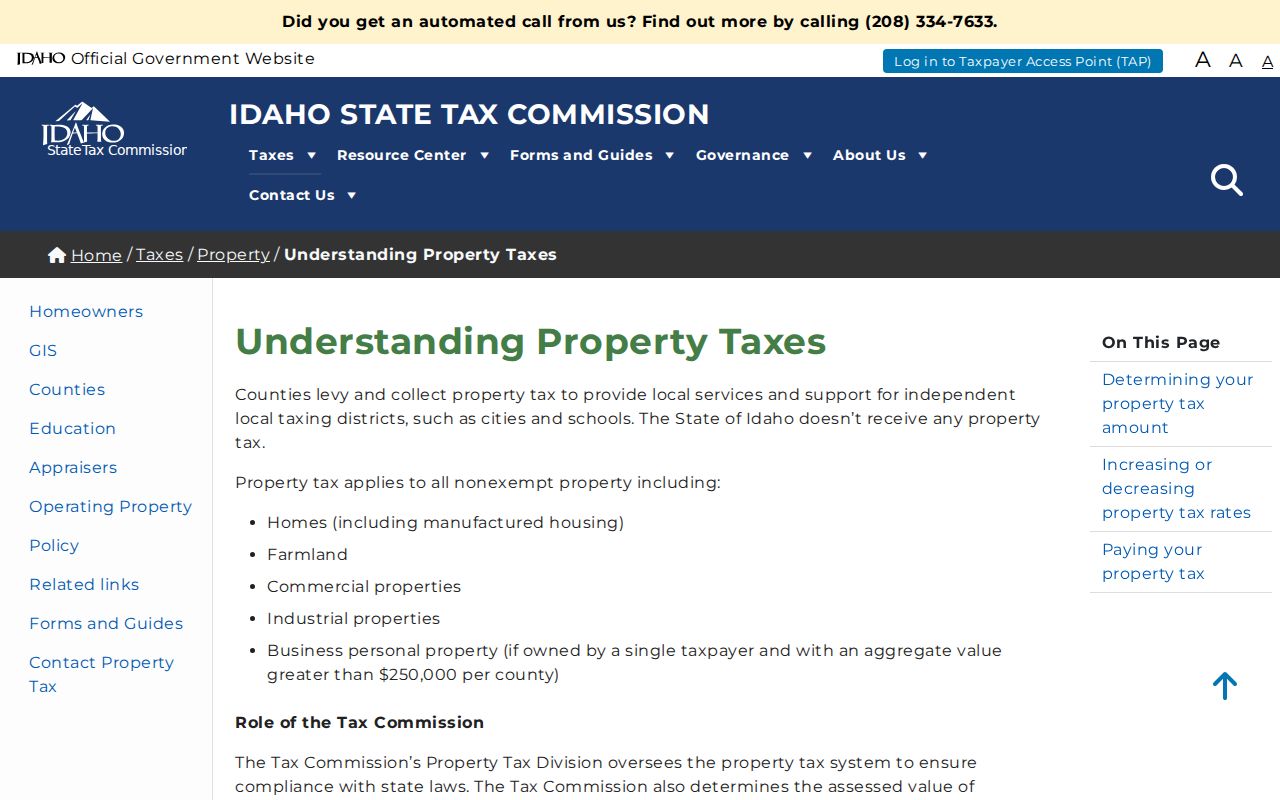
The capture supports the statewide framework; county offices supply parcel-specific answers.
Check the Official Homeowner Exemption Source
Open the Idaho State Tax Commission homeowner's exemption page for the current statewide guidance. Contact the county only after reading it.
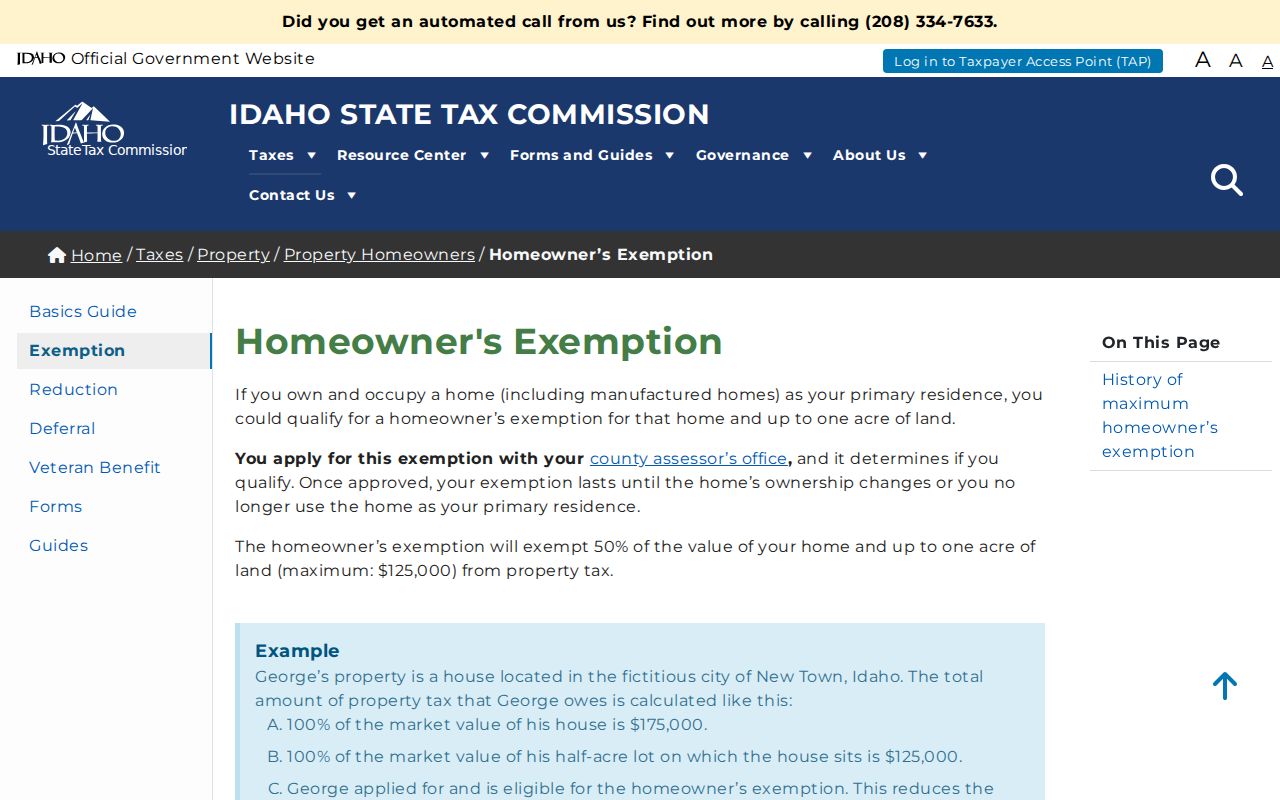
The state page lays out the Idaho program itself. The Butte County Assessor confirms application details, timing, and whether an exemption appears on a specific parcel.